CUSTOMER CONFIDENCE
The difficult customer conversation.
Exposure of names, addresses, or order history can lead to worried calls and customers hesitating to buy again. Reassurance takes work long after a technical fix.
PROFESSIONAL SERVICES / ECOMMERCE MIGRATION
I help growing retailers move to Shopify and Shopify Plus with AI-assisted delivery, validated data, tested integrations, and a launch plan built around business continuity.

Nicholas (Niccolo) Roberts
Hands-on technology & operations leadership
Catalog · Customers · Orders · Custom workflows
Reconciled data, tested connections, and a launch plan your team can follow.
Storefront · Checkout · Merchandising
WHY MIGRATE / CUSTOMER TRUST & BUSINESS RISK
An ageing Magento and PHP stack can turn maintenance into a recurring business constraint. If a vulnerability is exploited, the impact can reach customer records, daily sales, and the team responsible for recovery.
Exposure depends on your versions, patch history, extensions, and configuration. On a self-managed store, your team and providers must keep those layers current.
CUSTOMER CONFIDENCE
Exposure of names, addresses, or order history can lead to worried calls and customers hesitating to buy again. Reassurance takes work long after a technical fix.
TRADING CONTINUITY
Containment can mean disabling checkout or taking parts of the store offline. Paid traffic, fulfillment commitments, and customer support need decisions while the incident is investigated.
BUDGET & FOCUS
Emergency specialists, data checks, and customer communications can consume the budget and time intended for merchandising, conversion improvements, and new sales channels.
PHP’s end-of-life branches stop receiving upstream security fixes. PHP support policy
Adobe’s September 8, 2026 Commerce and Magento Open Source update addressed flaws including security bypass and privilege escalation. Adobe reported no known exploitation of those issues when it published the bulletin. Adobe security bulletin
THE ADVANTAGE OF A HOSTED PLATFORM
A Shopify-hosted storefront replaces the customer-facing Magento/PHP application with a platform operated by Shopify. Your team no longer runs that Magento application and its PHP runtime for the storefront.
Shopify plans include commerce hosting and TLS/SSL certificates. Its Level 1 PCI DSS compliance covers the Shopify store, checkout, and hosting. Hosting details · PCI scope
That shift can free capacity for product launches, merchandising, and customer experience. The business case compares those priorities with the full cost of plans, apps, transactions, and integrations.
THE RESPONSIBILITIES YOU KEEP
Your team still owns staff access, app permissions, API credentials, customer-data handling, and the custom systems connected to the store. Any retained PHP services still need support and patching.
Shopify recommends individual staff accounts and permissions, plus passkeys or two-step authentication. Apps and custom code need review too. Shopify account security · Custom pixel security
The migration plan includes access review, integration ownership, and the retirement of the old store after reconciliation and retention requirements are agreed.
Start with your actual PHP version, Magento patch level, and extension inventory. Keep urgent remediation moving while the migration is planned.
Review my migration optionsDELIVERY EXPERIENCE / DIGITAL BEVERAGE GROUP
As Director of Technology & Operations, I led modernization from Offset Figure to Shopify Plus and Linnworks for a multi-brand wine business. I built Python and Pandas workflows for historical order and customer migration.
Historical orders migrated
Historical order value represented
The figures describe historical data migrated, not new sales generated.
The wider operating role spans four commerce storefronts, two React Native apps, and six commerce models, including flash sales, private sales, auctions, and wine clubs.
Read the portfolio case PDF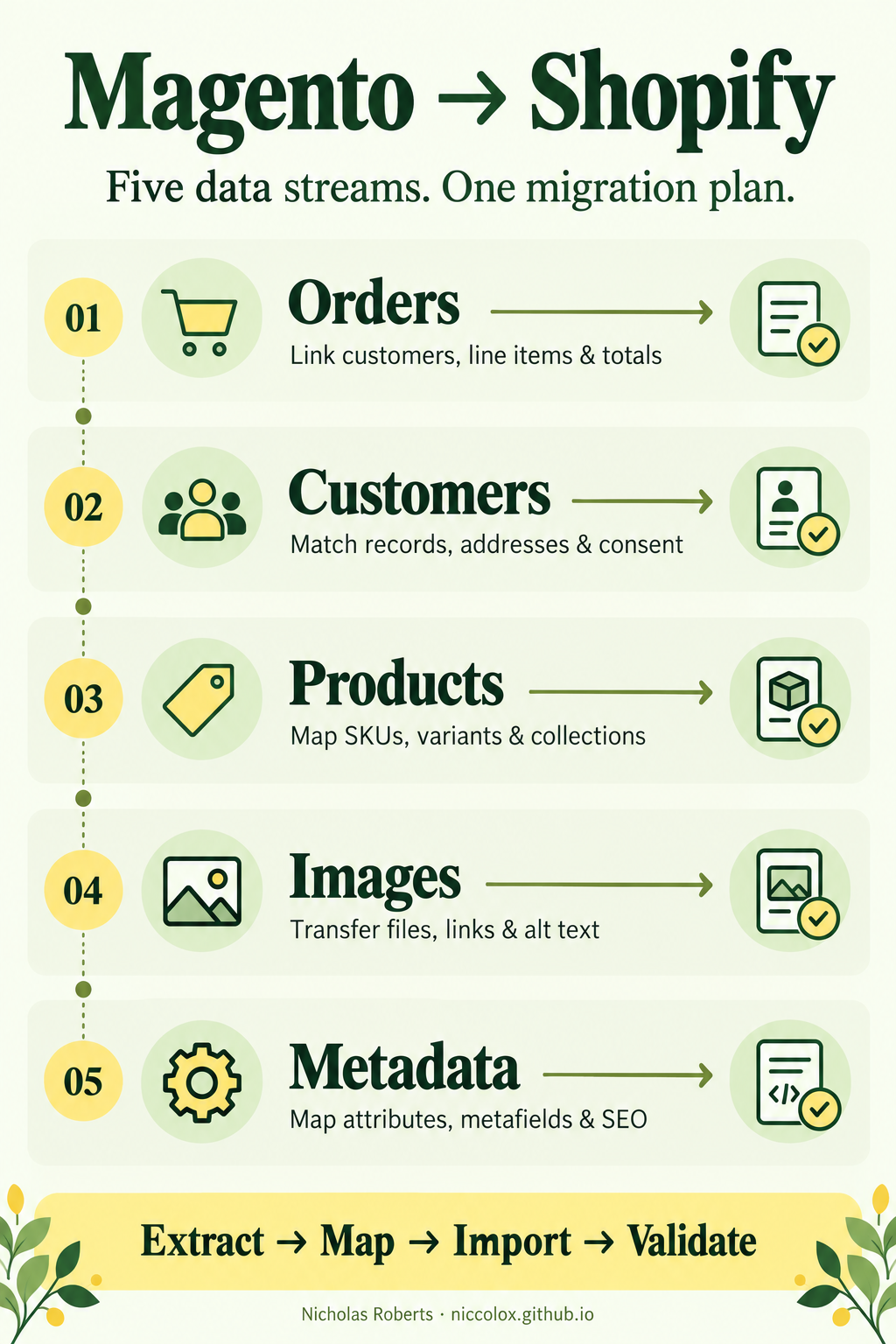
Five data streams, mapped and checked before launch. Select the infographic to enlarge.
MIGRATION SERVICES
For established retailers with a working Magento store, valuable customer history, and systems that need to keep exchanging orders, stock, and financial data.
Review your Magento and PHP versions, patch status, extensions, catalog, and custom workflows. Get a migration blueprint with dependencies, platform decisions, delivery phases, and acceptance criteria.
Map products, attributes, customer records, and historical orders. Validate relationships, reconcile counts and values, and resolve exceptions before the final import.
Deliver the agreed Shopify storefront, collections, search, and merchandising journeys. Test mobile shopping, checkout, discounts, and customer communications against real business scenarios.
Plan and implement warehouse, ERP, finance, shipping, and marketing connections. Trace test orders through fulfillment, cancellation, and refund workflows with the people who operate them.
Map important URLs, prepare supported redirects, and check content and metadata. Validate analytics events and monitor high-value landing pages after launch.
Coordinate final data updates, stock reconciliation, domain changes, and launch checks. Define recovery decisions, ownership, team training, and the agreed support period.
Operational experience includes Shopify Plus, Linnworks, NetSuite, Klaviyo, AfterShip, Python, and SQL. Integration choices are scoped to your existing systems.
HOW THE ENGAGEMENT WORKS
Each phase produces something your team can review. Scope, fees, and timing are agreed around the work your store needs.
Review the store, data, and integrations with your team.
You review: the migration blueprint and phased proposal.
Build the storefront, migration workflows, and agreed integrations.
You review: a working environment and sample data.
Reconcile data and test buying, fulfillment, and exception scenarios.
You review: test results, exceptions, and the launch runbook.
Coordinate the switch, monitor trading, and support your operators.
You receive: handover notes, training, and a support plan.
BEFORE YOU COMMIT
Migration choices affect your customers and the people running your store. Discovery makes those decisions explicit.
Catalog complexity, order history, custom workflows, integrations, and storefront requirements determine the work. After assessment, you receive a phased proposal with scope, fees, dependencies, and a delivery schedule.
The assessment compares your requirements with Shopify’s current plans, app costs, and customization options. That comparison informs the recommendation before the build is scoped.
Encrypted passwords are not imported into Shopify. The migration plan includes customer communications and the account sign-in or activation approach selected for your store. See Shopify’s migration checklist.
Important pages are mapped to their new destinations, with supported redirects, metadata checks, and testing before and after launch. Search performance can change during a migration; ranking guarantees are not part of the offer. Shopify’s redirect rules inform the plan.
Each workflow is reviewed with its business owner. The blueprint records what will use Shopify capabilities, what needs an app or custom integration, and what your team chooses to retire. Subscriptions, store credit, and specialist selling models are assessed individually.
Yes. The engagement can cover migration leadership or a defined delivery scope, such as data and integrations. Responsibilities, decision owners, and handover requirements are agreed at the start.
LET’S SCOPE YOUR MIGRATION
Tell me what is prompting the move and what needs to work when you launch. We can discuss the right scope for a migration assessment.
Email about your migration niccolox@devekko.comNicholas (Niccolo) Roberts · San Francisco Bay Area