CYBERSECURITY / SYSTEMS THINKING
Cyberpolycrisis
network map
Where separate risks meet shared systems.
Twenty-six security topics point toward a smaller set of operational dependencies. Mapping their overlap shows where credentials, AI tools, software delivery and recovery capacity can amplify a business’s exposure.
- Core issue themes
- 23
- Shared exposure areas
- 6
- Issue-to-area links
- 55
VISUAL BRIEFING / ALL 26 TOPICS
The 26-topic infographic.
Two columns bring the complete register into one view. Evidence labels distinguish incidents from research, policy, vulnerabilities and related remediation. The numbered text list below adds context, actions and source links.
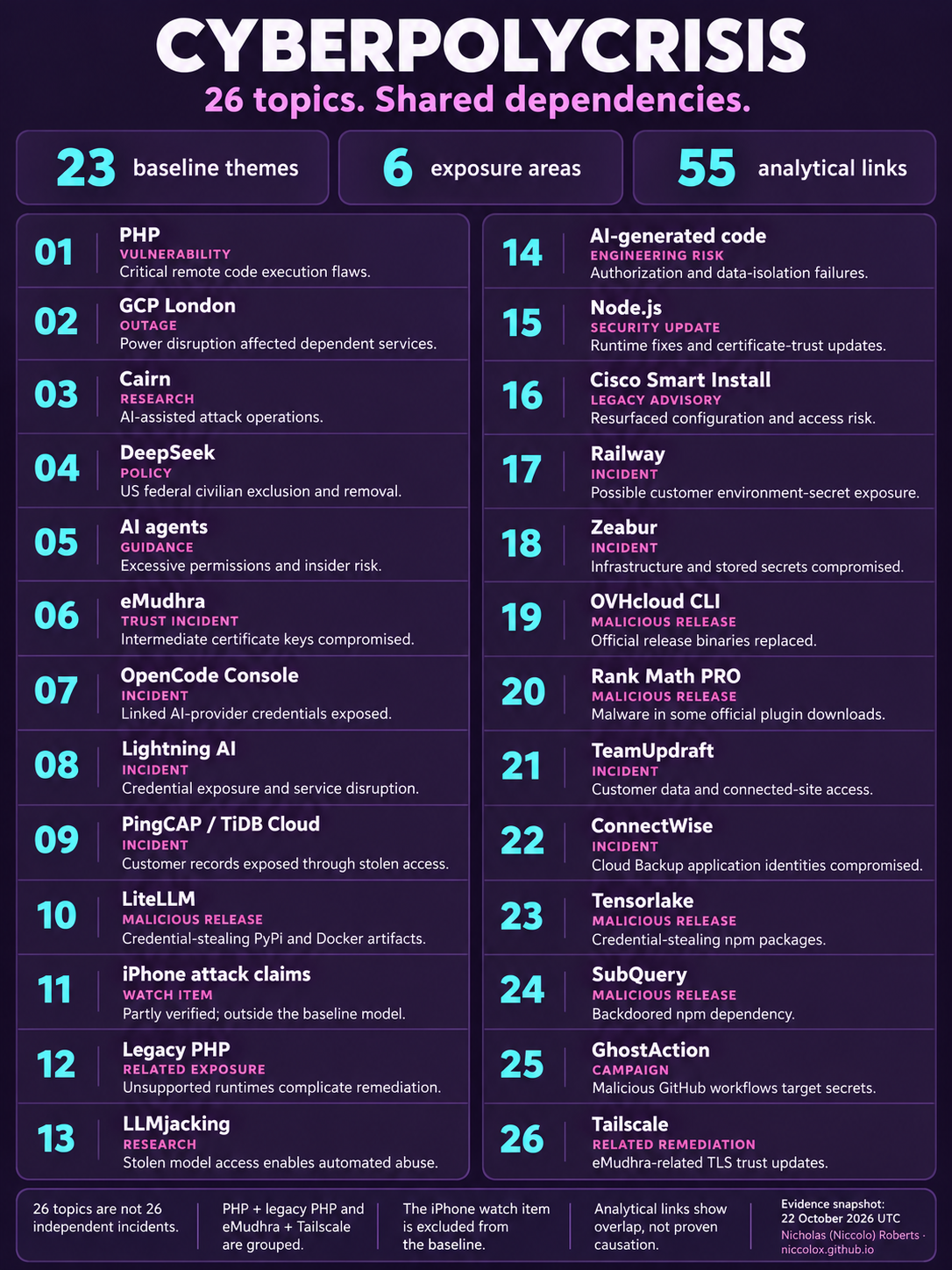
COMPLETE REGISTER / 01–26
Every topic, with context.
The numbers match the infographic and downloadable register. Read each column from top to bottom; the list stacks on mobile. Priority is an operational judgment for organizations with the stated exposure, not a CVSS score. Conditional priorities require the specific exposure to be established.
-
PHP
Vulnerability
Critical remote code execution flaws affect PHP deployments; exposure depends on the installed version and configuration.
Action: Deploy supported security releases or verified vendor backports, then confirm running workers and images.
Priority: Critical
PHP release advisory ↗ -
GCP London
Outage
A power event disrupted cloud workloads and dependent services, including banking. The incident report does not establish a cyberattack.
Action: Verify recovery, reconcile queued transactions and test recovery across zones or regions.
Priority: High
Google incident report ↗ -
Cairn
Research
Researchers documented AI-assisted attack operations. Observed attack projects are not confirmed victims, and worker names do not establish Claude model involvement.
Action: Prioritize exposed application flaws and investigate unexpected files, sessions and service credentials.
Priority: High
NorForge investigation ↗ -
DeepSeek
Policy
A US federal civilian exclusion and removal order creates procurement and embedded-model dependencies for covered agencies and suppliers.
Action: Inventory model dependencies and check the order’s scope, exceptions and obligations with procurement and legal owners.
Priority: High (conditional)
Federal Register order notice ↗ -
AI agents
Guidance
Microsoft’s insider-risk guidance concerns excessive agent permissions and consequential actions. It is not disclosure of a single customer breach.
Action: Assign owners and separate identities; enforce permission limits, approvals and auditable tool use outside the model.
Priority: High (conditional)
Microsoft: Securing the agentic insider ↗ -
eMudhra
Trust incident
Compromised intermediate certificate keys create impersonation risk where affected chains remain trusted. This concerns authentication, not a break in TLS encryption.
Action: Update the trust stores applications actually use and replace affected chains; keep certificate verification enabled.
Priority: Critical (conditional)
Cloudflare response ↗ -
OpenCode Console
Incident
The vendor reported exposure of linked AI-provider credentials for a subset of Console users. This scope does not include every local OpenCode installation.
Action: Revoke affected provider keys and review inference activity, billing and account limits.
Priority: Critical (conditional)
OpenCode incident statement ↗ -
Lightning AI
Incident
Unauthorized credential access led to platform disruption. The vendor’s notice distinguishes affected platform services from GPU rental and managed Kubernetes/SLURM services.
Action: Rotate exposed third-party credentials, review connected services and activate continuity arrangements.
Priority: Critical (conditional)
Lightning incident notice ↗ -
PingCAP / TiDB Cloud
Incident
Stolen service-account access exposed customer records and internal information. The vendor reported no evidence that data stored in TiDB was impacted.
Action: Follow management API-key replacement guidance, review logs and verify unusual payment or credential requests.
Priority: High
PingCAP incident report ↗ -
LiteLLM
Malicious release
Malicious PyPI wheels and an official Docker image for 1.107.0 targeted credentials. Artifact exposure matters even where source review finds no payload.
Action: Isolate affected execution environments, replace reachable secrets from a clean system and rebuild from verified artifacts.
Priority: Critical (conditional)
JFrog investigation ↗ -
iPhone attack claims
Watch item
Research proposes a proximity attack chain, but its scope and Cellebrite attribution remain partly unverified. This item is outside the baseline model.
Action: Apply supported Apple security updates and escalate suspected targeted compromise to mobile incident responders.
Priority: High (conditional)
Underlying research ↗ -
Legacy PHP
Related exposure
Unsupported runtimes complicate remediation. This overlaps with item 01; it is not an independent attack or evidence of an Internet-wide failure.
Action: Locate legacy installations, obtain patch assurance from hosts and migrate to supported versions.
Priority: Critical (conditional)
Current PHP guidance ↗ -
LLMjacking
Research
Honeypot research shows attempted abuse of model access and agent tooling. Allowed automated steps are not a count of completed attacks.
Action: Authenticate endpoints, restrict key scope and agent network access, and monitor unusual inference spending.
Priority: High
Symantec/Broadcom research ↗
-
AI-generated code
Engineering risk
The cited example concerns cross-user document exposure and authorization failures. It does not establish a universal failure rate for generated applications.
Action: Review generated changes and test tenant isolation, authorization and business logic before production use.
Priority: High (conditional)
Original commentary ↗ -
Node.js
Security update
October security releases address runtime vulnerabilities and the eMudhra certificate-trust dependency.
Action: Deploy a patched supported release and verify rebuilt applications and their active trust stores.
Priority: High
Node.js security release ↗ -
Cisco Smart Install
Legacy advisory
An older advisory about provisioning and configuration access has resurfaced. This is not a newly disclosed October 2026 breach.
Action: Inventory affected equipment, disable unused Smart Install and restrict management access.
Priority: High (conditional)
NSA advisory ↗ -
Railway
Incident
The vendor disclosed possible exposure of customer environment secrets and initially paused deployments. Customer-specific impact remained under investigation.
Action: Rotate stored credentials and inspect downstream use, following the vendor’s containment and recovery guidance.
Priority: Critical
Railway disclosure ↗ -
Zeabur
Incident
Internal credentials opened shared infrastructure and customer secrets, including stored environment variables and database access.
Action: Rotate stored passwords and keys and investigate affected workloads and databases.
Priority: Critical
Zeabur preliminary report ↗ -
OVHcloud CLI
Malicious release
Official release binaries were replaced during a limited download window. Source-code review alone cannot verify the safety of downloaded release assets.
Action: Check artifact hashes and download timing, contain affected hosts and replace accessible secrets.
Priority: Critical
OVHcloud advisory ↗ -
Rank Math PRO
Malicious release
Malware reached a subset of official PRO 3.0.123 downloads. Updating the plugin alone does not remove persistence from an affected site.
Action: Recover affected sites from verified inputs, investigate persistence and replace compromised credentials.
Priority: Critical
Rank Math recovery guidance ↗ -
TeamUpdraft
Incident
The vendor believes customer data was accessed and confirms abuse of connected-site access. This does not establish compromise of the UpdraftPlus distribution itself.
Action: Reset access, enable MFA and inspect connected and Premium sites using the vendor’s current instructions.
Priority: Critical (conditional)
TeamUpdraft incident and customer actions ↗ -
ConnectWise
Incident
Cloud Backup application identities were compromised. Backup archive compromise was not confirmed; delegated access to live Microsoft 365 tenants requires investigation.
Action: Review tenant activity and keep affected connections disabled until service-specific restoration instructions permit reconnection.
Priority: Critical
ConnectWise Trust Center and remediation guide ↗ -
Tensorlake
Malicious release
Malicious npm 0.5.144 packages could steal credentials. The advisory includes a token-monitor service that makes containment order important.
Action: Isolate hosts and remove the token monitor before GitHub-token revocation; follow the advisory and rebuild from verified inputs.
Priority: Critical
Tensorlake advisory and recovery sequence ↗ -
SubQuery
Malicious release
@subql/common 5.8.3 contained a credential stealer and backdoor. Both installation and import can trigger execution, including through transitive dependencies.
Action: Check resolved dependencies, isolate affected hosts and rotate exposed credentials from a clean environment.
Priority: Critical
StepSecurity investigation ↗ -
GhostAction
Campaign
Compromised GitHub accounts injected secret-stealing workflows into repositories. Campaign activity does not establish a common actor across every topic here.
Action: Remove malicious workflows and revoke both the entry credential and exposed CI secrets.
Priority: Critical (conditional)
GitGuardian campaign tracking ↗ -
Tailscale
Related remediation
The eMudhra response concerns TLS certificate trust. Standard WireGuard mesh traffic is unaffected; this is not a separate confirmed Tailscale breach.
Action: Update to 1.104.2 or later and follow the relevant security bulletin. This response is grouped with item 06.
Priority: High
Tailscale security bulletin TS 2026 013 ↗
Most incidents have no established unique affected-user count. The full register includes impact, affected populations, evidence status and owner-specific actions.
01 / THE NETWORK
Credentials sit at the intersection.
The strongest overlap is between AI tooling and credentials or permissions. Ten of the core themes involve both. Software delivery connects that cluster to the systems used to build, deploy and operate the business.
This extends The Cybersecurity Polycrisis and the original 16-topic thread, now expanded with ten entries from the subsequent issue list. The original article covered eight events and their operational consequences. This analysis asks a different question: which exposures recur across the larger set, and which controls address several of them?
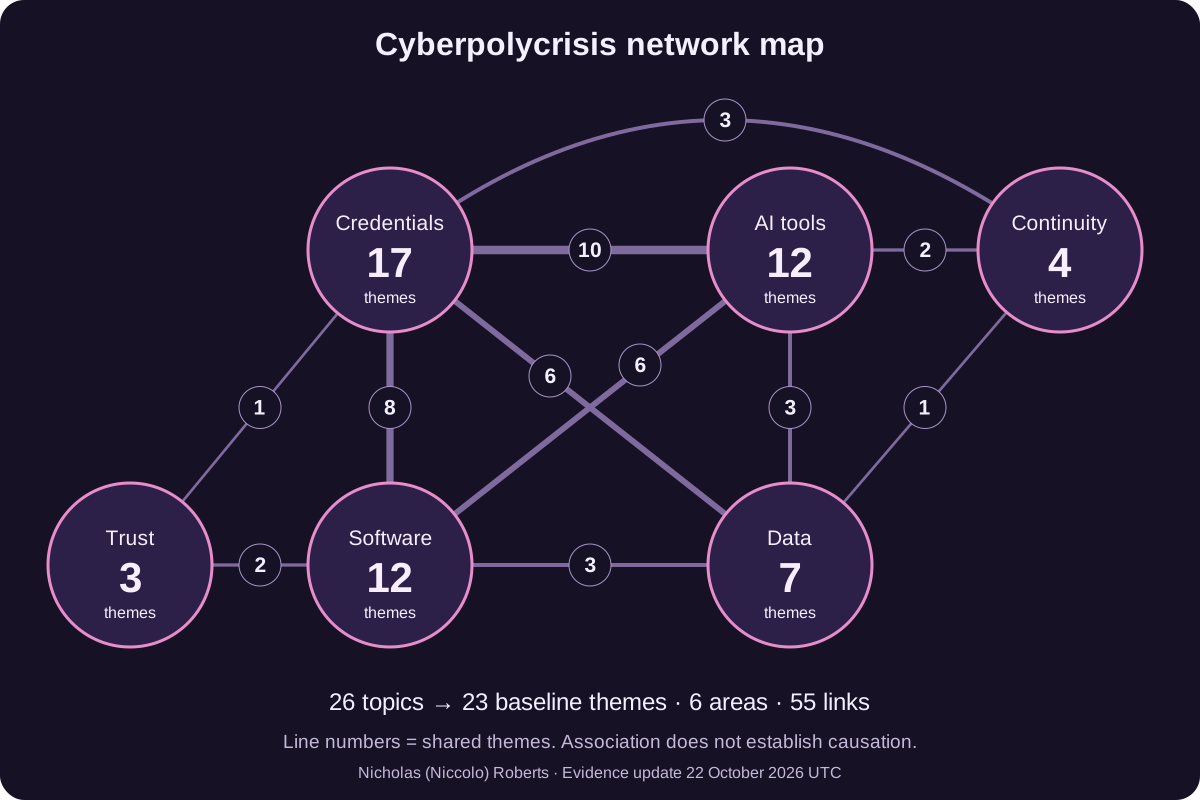
- Credentials ↔ AI tools10
- Credentials ↔ Software8
- Credentials ↔ Data6
- Software ↔ AI tools6
- Credentials ↔ Continuity3
- Software ↔ Data3
- AI tools ↔ Data3
- Software ↔ Trust2
- AI tools ↔ Continuity2
- Credentials ↔ Trust1
- Data ↔ Continuity1
Twenty-six topics become twenty-three baseline themes. PHP and legacy PHP are counted together. Tailscale’s eMudhra response is grouped with the certificate incident, rather than counted as a separate breach. The partly verified iPhone attack claim is retained as a watch item outside the baseline. Policy changes, guidance and research remain explicitly distinct from confirmed incidents.
The sources do not establish a single attacker or coordinated campaign. Shared exposure matters because separate incidents can still draw on the same credentials, staff and recovery systems.
02 / SHARED EXPOSURE
Six places to investigate overlap.
Each theme is connected only to areas central to its documented mechanism or response. Generic downstream consequences are excluded. The counts help identify common controls; they do not replace exposure assessment.
Credentials and authorization
17AI agent governance · OpenCode Console · Lightning AI · PingCAP / TiDB Cloud · LiteLLM 1.107.0 · LLMjacking · AI-generated code · Cisco Smart Install · Railway environment secrets · Zeabur infrastructure breach · OVHcloud CLI release assets · Rank Math PRO plugin malware · TeamUpdraft data and site access · ConnectWise backup identities · Tensorlake npm compromise · SubQuery npm backdoor · GhostAction workflow injection.
Common control: limit authority, separate identities and revoke exposed access. Key theft and missing authorization require different fixes within the same boundary.
AI tools and model dependencies
12Cairn · DeepSeek federal policy · AI agent governance · OpenCode Console · Lightning AI · LiteLLM 1.107.0 · LLMjacking · AI-generated code · Railway environment secrets · OVHcloud CLI release assets · Tensorlake npm compromise · GhostAction workflow injection.
Common control: maintain an inventory of models, tools, providers, delegated permissions and accountable owners.
Software execution and delivery
12PHP and legacy PHP · Cairn · eMudhra / Tailscale remediation · LiteLLM 1.107.0 · AI-generated code · Node.js · OVHcloud CLI release assets · Rank Math PRO plugin malware · TeamUpdraft data and site access · Tensorlake npm compromise · SubQuery npm backdoor · GhostAction workflow injection.
Common control: verify deployed versions and installed artifacts, patch exposed systems, and review generated changes. A source review alone does not verify a distributed package.
Data exposure and isolation
7Cairn · AI agent governance · PingCAP / TiDB Cloud · AI-generated code · Zeabur infrastructure breach · TeamUpdraft data and site access · ConnectWise backup identities.
Common control: test who can access each customer’s information, limit agent access and investigate unusual exports. Supplier metadata exposure does not establish compromise of all stored customer data.
Network and certificate trust
3eMudhra / Tailscale remediation · Node.js · Cisco Smart Install.
Common control: update the certificate stores applications actually use, restrict management interfaces and disable unused provisioning. Keep certificate verification enabled.
Service continuity
4GCP London · Lightning AI · Railway environment secrets · ConnectWise backup identities.
Common control: test recovery when a supplier is unavailable and normal credentials cannot be trusted. This narrow count includes observed outages, rather than every risk that could disrupt service.
03 / FOUR CONNECTIONS
How exposure can compound.
Some connections are directly documented. Others are scenarios for an organization that uses the affected technologies. Keeping that distinction visible makes the map useful for decisions.
DOCUMENTED MECHANISM / CONDITIONAL DOWNSTREAM IMPACT
An AI gateway can concentrate access to many providers.
JFrog’s analysis of LiteLLM 1.107.0 found malicious published artifacts that targeted developer, cloud and AI credentials, including provider secrets stored by an AI proxy. That creates a concrete route from an affected execution environment to accounts outside it. The full downstream impact depends on the credentials present and their permissions. JFrog investigation ↗
- Affected package executes
- Reachable secrets are collected
- Connected accounts may be exposed
Removing the package does not revoke secrets already copied. Containment needs to cover the host, the identities it could access and activity at the destination services. OpenCode, Lightning and LLMjacking reinforce the importance of this boundary without establishing that their incidents share an attacker or access path.
DOCUMENTED CROSS-ISSUE DEPENDENCY
Certificate remediation travels through the software stack.
Node.js’s October security release explicitly includes certificate updates for the eMudhra compromise. This is a verified connection between two entries in the register. Tailscale’s advisory adds another documented remediation path: update to 1.104.2 or later. Its standard WireGuard mesh traffic is unaffected. Tailscale bulletin ↗ An application may rely on its operating system, runtime, HTTP library or a bundled certificate store to validate a connection. Node.js advisory ↗
- Affected certificate trust
- Runtime and trust-store updates
- Application rebuild and verification
Cloudflare advises checking the application’s actual validation path. A browser check does not establish that a background service is protected. The practical task is to identify every deployed verifier, apply the relevant update and confirm the running application uses it. Cloudflare guidance ↗
OBSERVED OUTAGES / ORGANIZATION-DEPENDENT OVERLAP
Containment and continuity can compete for the same resources.
Lightning’s notice describes a credential incident followed by platform access being revoked. Google’s London incident followed a power event. The notices establish different causes. They also illustrate why an operations team may need to restore service while access is being withdrawn elsewhere. Lightning notice ↗ · Google incident report ↗
- Supplier capacity becomes unavailable
- Security response also restricts access
- Recovery needs an independent path
For a medium-sized business, the same people may own cloud recovery, credential rotation and customer communications. Railway’s initial deployment pause and ConnectWise’s phased backup restoration add current examples of restricted recovery capacity. Railway disclosure ↗ · ConnectWise updates ↗ Recovery procedures should remain usable when a normal supplier, identity path or development environment is unavailable. A failover plan that depends on the affected control plane needs another route.
GOVERNANCE GUIDANCE / ANALYTICAL SCENARIO
Agent permissions can amplify an application’s authorization defect.
Microsoft’s guidance describes agents with excessive access to data, tools and operational systems. The AI-generated-code example in the register concerns cross-user document exposure. Together, they suggest a scenario worth testing: an authorized agent encounters data that the application has failed to isolate and distributes it through permitted tools. This is an inference, not an observed chain connecting the named events. Microsoft guidance ↗ · Code-assurance commentary ↗
- Weak application isolation
- Agent has broad read and write access
- Information crosses a business boundary
The controls belong outside the model: authorization checks, tenant isolation, narrowly scoped identities, approval for consequential actions and auditable tool activity. A prompt describing the intended behavior cannot enforce an application’s access boundary.
04 / RESPONSE PRIORITIES
Act on the shared boundary.
Connectivity identifies opportunities to reduce several exposures together. It does not decide urgency by itself. Confirmed compromise, internet exposure, sensitive data and business dependency should determine what happens first.
Contain credentials and delegated authority.
Identify which keys, service accounts, sessions and agent identities were reachable from affected tools. Follow incident-specific containment sequencing, including Tensorlake’s token-monitor removal before GitHub-token revocation. Revoke exposed access, replace secrets from a clean environment and review their use across connected systems. Separate production, development and agent permissions.
Evidence of completion: old credentials no longer work, replacement scope is documented, and destination-service logs have been reviewed.
Restore confidence in deployed software.
Inventory affected versions and distribution artifacts, patch exposed runtimes and rebuild compromised environments from verified inputs. Treat generated code as production code requiring review and authorization tests. Verify the running environment, not only the intended configuration.
Evidence of completion: deployed versions and artifact identifiers are recorded; affected workloads have been checked after restart or redeployment.
Verify trust and data boundaries.
Check the certificate store each application uses. Restrict management services, disable unnecessary provisioning and test cross-user access. Confirm agents can only read and change the information their task requires.
Evidence of completion: validation and isolation tests pass through the application’s actual production paths.
Keep recovery independent and suppliers visible.
Test backups, emergency access, recovery procedures and customer communications under a supplier outage. Record embedded AI dependencies as well as direct purchases. Organizations affected by the DeepSeek federal order should check scope, exceptions and obligations with their procurement and legal owners. Federal Register notice ↗
Evidence of completion: a recovery exercise works with the normal supplier or identity path unavailable, and model dependencies have accountable owners.
Fewer links do not mean less danger. The certificate-trust area has fewer connections in this selected set, yet it affects a widely used authentication mechanism. An exposed PHP service may require immediate attention even though the merged PHP theme has only one primary link in this model.
05 / METHOD & SOURCES
A transparent model, with explicit limits.
Updated 22 October 2026 UTC (21 October Pacific), based on the 26-topic issue register and the primary notices and research linked below. Time-sensitive statements are a snapshot; consult the source notices for subsequent changes.
How the map was constructed
- Normalize the topics. Merge PHP items 01 and 12, and eMudhra with its Tailscale response (06 and 26). Keep the iPhone claim as a separate watch item. This leaves 23 baseline themes, including incidents, vulnerabilities, policy, guidance and research.
- Assign primary exposure areas. Connect a theme to an area when that area is central to its documented mechanism or response. Exclude generic consequences that could be attached to almost any risk.
- Count the associations. The baseline has 55 links between 23 themes and six areas. The displayed network then connects areas that share themes. One theme can contribute to more than one area-to-area connection.
- Check sensitivity. Including the iPhone claim adds one theme and two provisional links: software rises from twelve to thirteen and network trust from three to four. The credentials/AI overlap remains ten.
What the counts cannot establish
These are analyst-coded categories, not a measured network of a particular company’s systems. Category choices influence centrality. A higher count is not a probability, severity score, forecast loss or affected-user total.
The data does not establish common victims, a shared attacker, or a single campaign across these events. The Cisco item is an older advisory resurfacing in the discussion; DeepSeek is a policy dependency; the iPhone chain remains partly unverified.
To make this operational for a specific business, add its actual assets, deployed versions, secrets, supplier connections, trust stores and recovery dependencies. Then identify which customer services each of those supports.
Evidence behind the original 16 topics
- 01 & 12 / PHP and legacy PHP. PHP release guidance and CERT-EU advisory. One overlapping exposure theme.
- 02 / GCP London. Google incident report. Confirmed availability incident following a power event.
- 03 / Cairn. NorForge investigation. Research observations; attack projects are not a confirmed victim count.
- 04 / DeepSeek. DHS federal civilian exclusion and removal notice. Scope depends on the covered system or procurement.
- 05 / AI agents. Microsoft guidance. Governance concerns, not disclosure of a single customer breach.
- 06 / eMudhra. Cloudflare response and developer guidance. Certificate authentication and trust-store remediation.
- 07 / OpenCode Console. Vendor incident statement. A subset of Console users with external providers linked.
- 08 / Lightning AI. Vendor notice. Credential and platform-availability incident; the stated scope excludes GPU rental infrastructure and managed Kubernetes/SLURM services.
- 09 / PingCAP. Vendor incident report. Customer-record exposure; the vendor reports no evidence that data stored in TiDB was impacted.
- 10 / LiteLLM. JFrog analysis of 1.107.0. Malicious distributed artifacts and credential collection; no common campaign with the other entries is established.
- 11 / iPhone watch item. Underlying research and Apple bulletin. A separately confirmed fix does not prove the proposed chain or Cellebrite attribution.
- 13 / LLMjacking. Symantec/Broadcom research. Honeypot observations; allowed agent steps are not completed attacks.
- 14 / AI-generated code. Oege de Moor commentary. An engineering-risk example, not a universal failure-rate measurement.
- 15 / Node.js. Security release advisory. Includes the explicit eMudhra trust-store dependency.
- 16 / Cisco Smart Install. NSA advisory and Cisco guidance. Established configuration risk, not a newly disclosed October 2026 breach.
CONTINUE READING
The original briefing explores eight case studies and their business impact.