TECHNOLOGY / RESILIENCE / ADAPTATION
The Digital
Younger Dryas
When the operating environment changes faster than the organization.
A growing business can have capable people, useful products and modern technology, yet still be vulnerable to a sudden change in the systems it depends on. The next advantage may be the ability to keep trading while those dependencies are repaired or replaced.
VISUAL BRIEFING
Adapt to the conditions around you.
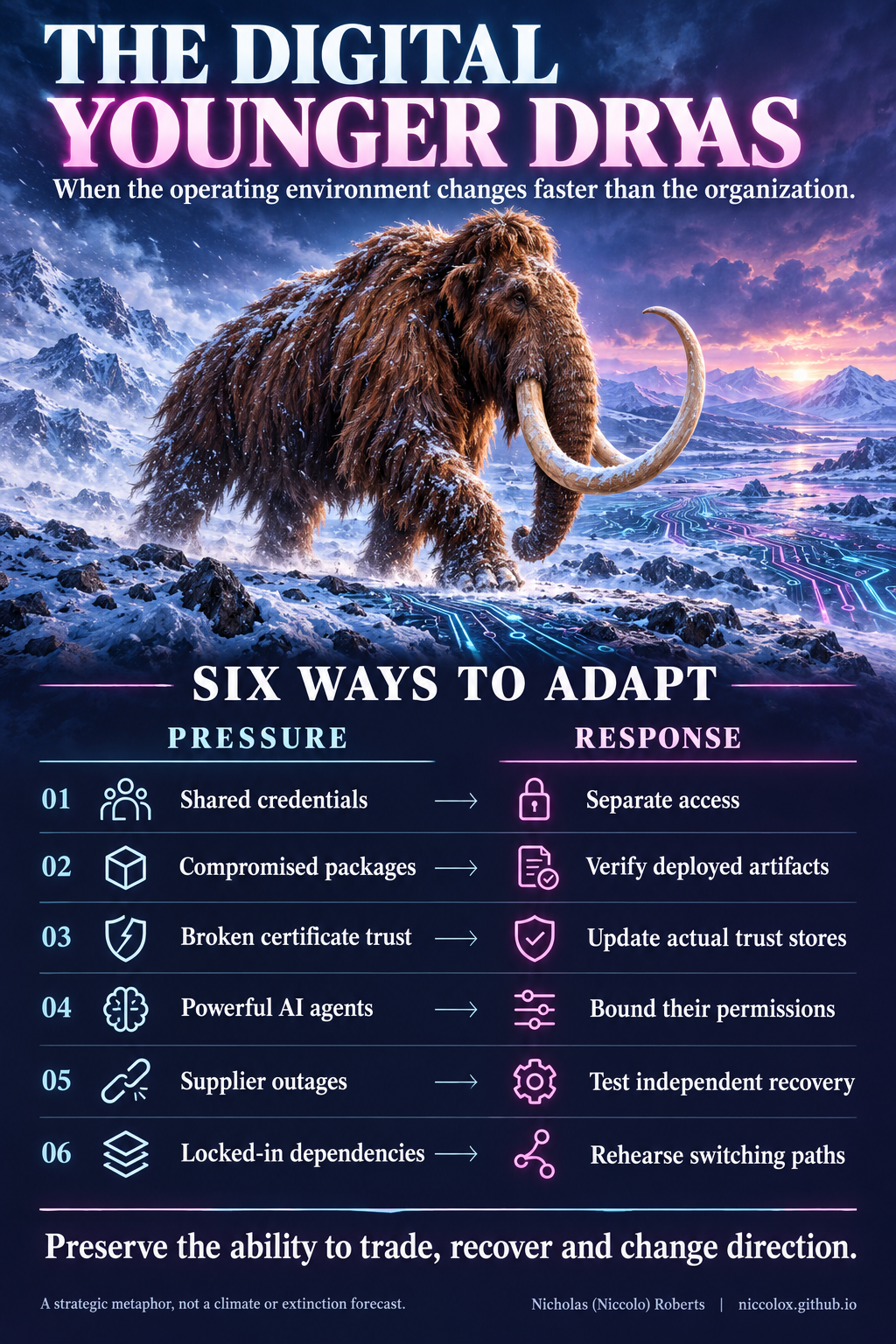
The woolly mammoth represents dependence on an entire environment. The six responses below translate that idea into decisions about access, software, trust and recovery.
01 / THE ANALOGY
A change in conditions can overturn a good operating model.
I use Digital Younger Dryas to describe a scenario in which several assumptions supporting digital growth become unreliable at the same time. Software distribution needs investigation. Credentials must be withdrawn. A supplier becomes unavailable. The team has to maintain service while changing the foundations underneath it.
The historical Younger Dryas interrupted the transition out of the last glacial period. It involved a return to colder conditions across much of the Northern Hemisphere, with different responses elsewhere. NOAA describes evidence linking the episode to changes in ocean circulation and freshwater routing. Its value as an analogy is the possibility of rapid change in a connected system. It does not give us a timetable for technology. NOAA’s Younger Dryas overview ↗
The mammoth also needs historical care. Mammoths did not all disappear at the beginning of the Younger Dryas. A population on Wrangel Island survived until around 4,000 years ago; a 2024 genetic study left the final cause of its extinction unresolved. The illustration therefore represents environmental dependence and adaptation, rather than a simple story about cold weather killing a species. Stockholm University’s research summary ↗
For a business, that dependence includes much more than servers. It includes the identities that authorize work, the software channels that deliver changes, the providers that process transactions, and the people who know how to restore service. A company’s apparent strength can conceal a narrow set of dependencies.
02 / THREE SIGNALS
The risk is in the connections.
The Cyberpolycrisis network map groups 26 topics into 23 baseline themes. It describes shared exposures, not a single campaign. Three examples show why a technology leader should look beyond individual incident tickets.
SOFTWARE DELIVERY
A familiar package can become a route into connected accounts.
JFrog documented credential-stealing payloads in LiteLLM 1.107.0 wheels and an affected official Docker image. The source archive did not contain the same payload files. That distinction makes the installed artifact, and the secrets reachable from its environment, central to the response. JFrog investigation ↗
The management implication is broader than removing one dependency: know which identities and services a build machine or AI gateway can reach. A replacement package does not automatically invalidate credentials already copied.
INHERITED TRUST
Trust changes can travel through the application stack.
The Node.js security release of 21 October 2026 explicitly includes certificate updates addressing the eMudhra intermediate CA compromise. A certificate incident can therefore require work in runtimes and deployed applications, beyond the browser or operating system. Node.js security release ↗
The operational task is to identify the verification path each application actually uses, apply the relevant update and check the running service. An inventory becomes useful when it points to an owner who can act.
SERVICE CONTINUITY
Recovery can become another dependency.
Google’s London incident report attributes the October disruption to a power event in europe-west2-b, with effects on regional services. The report does not establish a cyberattack. It illustrates how availability problems can coexist with security work for organizations using the affected services. Google incident report ↗
If the same people and access paths support both recovery and containment, those demands may compete. This is an organization-dependent scenario, not evidence that the named incidents caused one another.
03 / SIX ADAPTATIONS
Make resilience part of how the business operates.
For a medium-sized business pursuing growth, the practical aim is to preserve useful capacity without creating an unmanageable estate. These six responses are the text version of the infographic.
01 / SHARED CREDENTIALS
Separate access.
Give production, development, suppliers and AI agents distinct identities with narrow permissions. Keep an owner and revocation path for each important integration. Shared administrative credentials make otherwise separate services vulnerable to the same loss of access.
Check: revoke one integration’s access in a controlled exercise and verify that unrelated business services continue.
02 / COMPROMISED PACKAGES
Verify deployed artifacts.
Record what was installed, where it came from and which workload uses it. Retain known-good build inputs and a clean rebuilding path. Review source and distribution evidence together; a familiar name or signed release alone cannot establish that an artifact is harmless.
Check: rebuild a critical service from verified inputs without relying on the workstation suspected of compromise.
03 / BROKEN CERTIFICATE TRUST
Update actual trust stores.
Identify whether each service relies on operating-system, runtime or bundled certificate authorities. Assign remediation to the right owner and verify the application after restart or redeployment. Keep certificate checks enabled while repairing trust.
Check: test certificate validation through the application’s real connection path.
04 / POWERFUL AI AGENTS
Bound their permissions.
Match tool access, data visibility and spending authority to the task. Require approval for consequential actions and retain useful logs. A well-written instruction is valuable, but permissions and application controls must enforce the boundary.
Check: confirm an agent cannot read another customer’s data or perform an action beyond its delegated scope.
05 / SUPPLIER OUTAGES
Test independent recovery.
Protect backup access and recovery procedures from the same failure that affects production. Decide which services must continue, which can pause and how customers will be informed. A documented fallback earns confidence when people have used it.
Check: restore a critical workflow with its normal supplier or primary identity path unavailable.
06 / LOCKED-IN DEPENDENCIES
Rehearse switching paths.
Know how to export essential data, replace an integration and terminate delegated access. Choose alternatives where their business value justifies the cost. More suppliers can add complexity; the useful measure is whether a replacement path works when needed.
Check: complete a bounded export-and-restore or supplier-switching exercise and record the time, missing data and approvals.
04 / HYPOTHETICAL BUSINESS EXERCISE
A retailer loses its normal operating path.
This is a tabletop scenario for a growing commerce business. It is not a claim about a particular company or a documented chain linking the incidents above.
A retailer discovers that a development dependency may have exposed credentials used by its commerce integrations. The team isolates the affected environment and withdraws access. At the same time, an unrelated supplier disruption delays order-status synchronization. Checkout still works, but the business has less confidence in inventory updates, automated messages and its usual deployment route.
The impact comes from the interaction: accepting orders creates commitments while fulfillment visibility is reduced, and restoring the integration requires access that containment has just removed. Engineering, operations and customer service now need a shared decision about what can safely continue.
- Access becomes suspect
- Containment limits automation
- Customer commitments need a fallback
A prepared team has separate integration identities, a clean deployment route, recoverable order records and a documented manual queue. It can constrain affected channels, communicate realistic delivery expectations, restore a minimum viable workflow and reconcile exceptions before resuming automation.
Run the exercise with the people who own the customer promise. Record who can pause trading, approve replacement access, restore order processing and communicate delays. Success means meeting agreed recovery and data-loss limits with evidence, rather than merely showing that a backup exists.
05 / A PRACTICAL 30-DAY PLAN
Build the ability to change direction.
Use this as a starting sequence, adjusted for the business’s exposure and existing controls. Active compromise takes priority over the calendar.
Week 1: map the customer promise.
Select the workflows that protect revenue and customer trust. Map their systems, identities, software inputs, suppliers and recovery owners. Agree the tolerable interruption and data loss for each workflow.
Deliverable: a dependency map tied to business outcomes, with an accountable owner for each critical path.
Week 2: remove avoidable shared exposure.
Separate broadly shared identities, reduce agent permissions and address exposed or unsupported software. Verify relevant runtime and trust updates. Use incident-specific response instructions where compromise is suspected.
Deliverable: recorded access boundaries and deployed versions, with exceptions assigned to owners.
Week 3: rehearse a difficult recovery.
Run the retailer scenario against one real workflow. Remove a normal supplier or identity path from the exercise. Restore from verified inputs, account for missing or duplicated transactions, and test customer communications.
Deliverable: measured recovery time, data reconciliation results and the dependencies that prevented recovery.
Week 4: turn findings into operating decisions.
Fund the changes that remove the largest obstacles to continuity. Confirm supplier exit requirements and the cost of maintaining alternatives. Make the next exercise someone’s responsibility and keep the recovery evidence with the operating documentation.
Deliverable: a prioritized plan that connects resilience spending to customer commitments and growth capacity.
Growth needs room to adapt. A business that can contain a compromise, restore service and replace a dependency has more freedom to adopt useful technology. The Digital Younger Dryas is a way to test whether that freedom survives a sudden change in conditions.
Evidence snapshot: 22 October 2026 UTC (21 October Pacific). Historical facts and incident examples are linked to their sources. The analogy, six adaptations and tabletop exercise are the author’s analysis; they do not establish a common attacker, a universal trend or an inevitable outcome.